
Mastering the Building Envelope: A Comprehensive Guide to Façade Engineering
In the modern architectural landscape, a building’s façade is much more than just its “face.” It is a complex, high-performance system that requires specialized consultancy and expertise throughout the entire construction lifecycle. Whether a project is in the initial Concept Design or the final In Use phase, robust engineering is the backbone of a successful building envelope.
1. Laying the Foundation: Strategic Planning and Budgeting
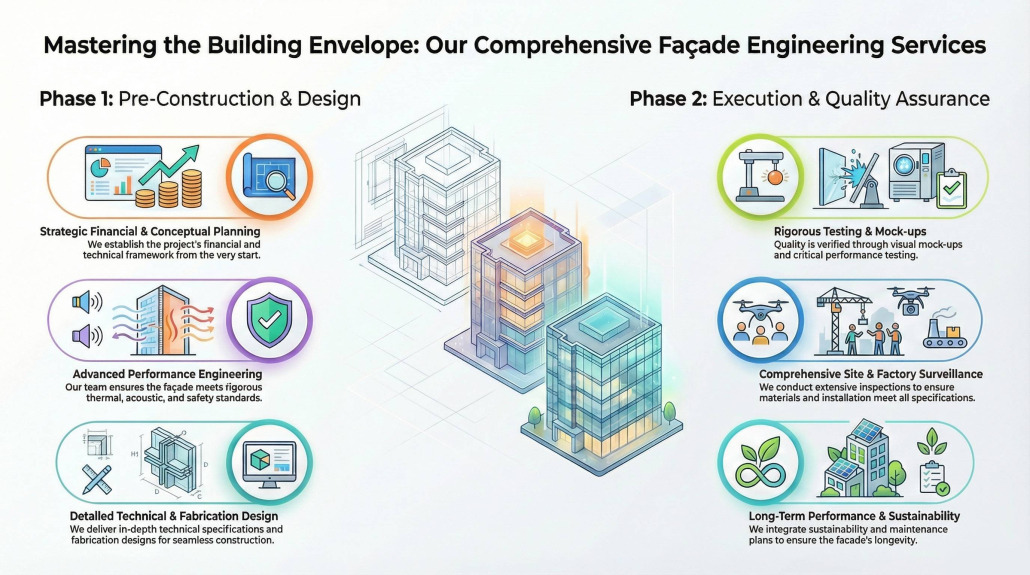
The success of a façade project is often decided long before the first panel is installed. During the Strategic Planning and Pre-Construction phases, it is essential to establish a solid financial and technical framework.
- Cost Management: Experts provide detailed cost information and perform budget checks to define the total project budget.
- Value Engineering: One of the most critical steps is implementing value engineering strategies, which optimize costs without compromising the building’s performance or aesthetic integrity.
- Conceptualization: This stage involves creating sketches, providing in-principle solutions, and advising on material selection to define the preliminary execution plan.
2. Technical Precision and Performance Engineering
Once the strategy is set, the focus shifts to Advanced Technical Engineering. Modern facades must meet rigorous standards for both aesthetics and functionality. This includes:
- Detailed Technical Design: Moving beyond concepts into fabrication design and detailed execution plans.
- Environmental Performance: To ensure occupant comfort, engineers manage thermal design and acoustic design assessments.
- Documentation: Comprehensive tender documentation is prepared, including performance specifications and schedules of services.
3. Mitigating Risk Through Testing and Quality Assurance
Execution is where theory meets reality. To prevent costly errors, thorough risk assessments are conducted to mitigate potential challenges during the project timeline.
Quality control is maintained through a series of rigorous checks:
- Mock-ups: Both Visual Mock-up designs and Performance mock-up testing are utilized to verify quality before full-scale installation.
- Surveillance: The process continues with site and factory inspections, alongside quantity surveillance, to ensure every material meets the specific project requirements.
4. Ensuring Long-Term Performance and Sustainability
A façade’s job isn’t over once construction ends. To ensure longevity, specialized plans for access and maintenance must be integrated from the start. Furthermore, a focus on sustainability ensures that the building remains efficient and environmentally responsible throughout its lifespan. For existing structures, building survey assessments provide vital data for ongoing performance.
Analogy for Better Understanding: Think of a building’s façade as a high-performance spacesuit for a skyscraper. It isn’t just there to look good; it has to regulate temperature (thermal design), block out noise (acoustic design), and withstand immense pressure, all while staying within a strict budget. Just as a spacesuit requires constant testing and specialized engineering to keep the astronaut safe, a façade requires expert consultancy to ensure the building survives and thrives in its environment.
3. Mitigating Risk Through Testing and Quality Assurance
Execution is where theory meets reality. To prevent costly errors, thorough risk assessments are conducted to mitigate potential challenges during the project timeline.
Quality control is maintained through a series of rigorous checks:
- Mock-ups: Both Visual Mock-up designs and Performance mock-up testing are utilized to verify quality before full-scale installation.
- Surveillance: The process continues with site and factory inspections, alongside quantity surveillance, to ensure every material meets the specific project requirements.
4. Ensuring Long-Term Performance and Sustainability
A façade’s job isn’t over once construction ends. To ensure longevity, specialized plans for access and maintenance must be integrated from the start. Furthermore, a focus on sustainability ensures that the building remains efficient and environmentally responsible throughout its lifespan. For existing structures, building survey assessments provide vital data for ongoing performance.
Analogy for Better Understanding: Think of a building’s façade as a high-performance spacesuit for a skyscraper. It isn’t just there to look good; it has to regulate temperature (thermal design), block out noise (acoustic design), and withstand immense pressure, all while staying within a strict budget. Just as a spacesuit requires constant testing and specialized engineering to keep the astronaut safe, a façade requires expert consultancy to ensure the building survives and thrives in its environment.


